SMA 230 • UNIT 6 • Mathematics
Curvilinear Coordinates
Syllabus Study Notes (Core Overview)
Free Overview Preview1. Core Concept Overview & Intuition
Curvilinear coordinates are coordinate systems whose coordinate surfaces are curved rather than flat. They are indispensable in advanced engineering, physics, and mathematics because many physical problems possess symmetries—cylindrical, spherical, or otherwise—that rectangular Cartesian coordinates obscure. By adapting the coordinate system to the geometry of the problem, the governing equations simplify dramatically.
The central idea is that a point in space may be located by three numbers $(U_1,U_2,U_3)$ that need not be distances along mutually perpendicular straight axes. Instead, each coordinate is constant on a surface. The three surfaces $U_1=c_1$, $U_2=c_2$, and $U_3=c_3$ intersect pairwise in curves called coordinate curves. These curves are the curvilinear analogues of the $x$, $y$, and $z$ axes of a rectangular system. When the three coordinate surfaces intersect at right angles everywhere, the system is called orthogonal. Both cylindrical polar coordinates and spherical polar coordinates are orthogonal systems.
The position vector of a point is a function of the three coordinates. As one coordinate varies while the other two are held fixed, the point traces out a coordinate curve, and the derivative of the position vector with respect to that coordinate gives a tangent vector to the curve. Normalizing this tangent vector produces a unit base vector. The magnitude of the un-normalized tangent vector is the scale factor, which records how much actual arc length is produced by a unit change in that coordinate. Scale factors are the bridge between coordinate increments and physical distances, and they control the formulas for arc length, volume element, gradient, divergence, and curl.
Two concrete systems anchor the whole theory. In cylindrical polar coordinates $(\rho,\phi,z)$, the point moves on a circle of radius $\rho$ when $\phi$ varies, moves radially when $\rho$ varies, and moves parallel to the $z$-axis when $z$ varies. In spherical polar coordinates $(r,\theta,\phi)$, the point moves radially when $r$ varies, along a meridian when $\theta$ varies, and around a parallel of latitude when $\phi$ varies. The scale factors for these systems are read off directly from these motions.
2. Mathematical Formalization & Core Definitions
> Definition (Curvilinear Coordinate System). A curvilinear coordinate system assigns to each point of space three coordinates $(U_1,U_2,U_3)$. The surfaces $U_1=c_1$, $U_2=c_2$, $U_3=c_3$ are the coordinate surfaces; their pairwise intersections are the coordinate curves. The system is orthogonal if the coordinate surfaces intersect at right angles.
> Definition (Scale Factor). For a coordinate $U_i$, the scale factor $h_{U_i}$ is the magnitude of the derivative of the position vector $\mathbf{r}$ with respect to $U_i$:
$$
h_{U_i}=\left\lVert\frac{\partial\mathbf{r}}{\partial U_i}\right\rVert,\qquad i=1,2,3.
$$
The unit base vector in the direction of increasing $U_i$ is then
$$
\hat{\mathbf{e}}i=\frac{1}{h.}}\frac{\partial\mathbf{r}}{\partial U_i
$$
Cylindrical Polar Coordinates
Let $P$ be a point with cylindrical coordinates $(\rho,\phi,z)$. The position of $P$ is a function of the three variables $\rho$, $\phi$, and $z$. The coordinate $\rho$ is the perpendicular distance from the $z$-axis, $\phi$ is the azimuthal angle measured about the $z$-axis, and $z$ is the height above the reference plane.
The unit base vectors are obtained by differentiating the position vector with respect to each coordinate and normalizing. When $\rho$ and $z$ remain constant and $\phi$ varies, $P$ moves round a circle of radius $\rho$; the derivative $\partial\mathbf{r}/\partial\phi$ is therefore a vector along the tangent to that circle at $P$, and the unit vector $\hat{\mathbf{e}}_2$ at $P$ is given by
$$
\hat{\mathbf{e}}_2=\frac{\partial\mathbf{r}}{\partial\phi}\Big/\left\lVert\frac{\partial\mathbf{r}}{\partial\phi}\right\rVert.
$$
If $\mathbf{F}(\mathbf{r})$ is a vector associated with $P$, then
$$
\mathbf{F}(\mathbf{r})=F_\rho\hat{\mathbf{e}}1+F\phi\hat{\mathbf{e}}_2+F_z\hat{\mathbf{e}}_3,
$$
where $F_\rho$, $F_\phi$, and $F_z$ are the components of $\mathbf{F}$ in the directions of the unit base vectors $\hat{\mathbf{e}}_1$, $\hat{\mathbf{e}}_2$, and $\hat{\mathbf{e}}_3$.
Spherical Polar Coordinates
Let $P$ be a point with spherical polar coordinates $(r,\theta,\phi)$. The coordinate $r$ is the distance from the origin, $\theta$ is the polar angle measured from the positive $z$-axis, and $\phi$ is the azimuthal angle measured about the $z$-axis.
If $r$ and $\phi$ remain constant and $\theta$ increases, $P$ moves along the meridian through $P$; the derivative $\partial\mathbf{r}/\partial\theta$ is a tangent vector to this circle at $P$, and the unit vector $\hat{\mathbf{e}}_2$ is
$$
\hat{\mathbf{e}}_2=\frac{\partial\mathbf{r}}{\partial\theta}\Big/\left\lVert\frac{\partial\mathbf{r}}{\partial\theta}\right\rVert.
$$
If $\mathbf{F}(\mathbf{r})$ is a vector associated with $P$, then
$$
\mathbf{F}(\mathbf{r})=F_r\hat{\mathbf{e}}1+F\theta\hat{\mathbf{e}}2+F\phi\hat{\mathbf{e}}_3,
$$
where $F_r$, $F_\theta$, and $F_\phi$ are the components of $\mathbf{F}$ in the directions of the base vectors $\hat{\mathbf{e}}_1$, $\hat{\mathbf{e}}_2$, and $\hat{\mathbf{e}}_3$. Both cylindrical and spherical polar coordinates are orthogonal.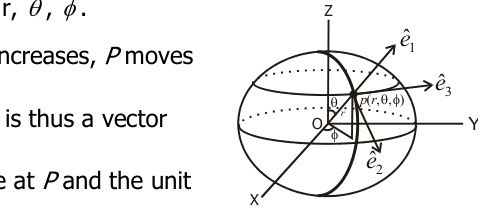
Scale Factors
For cylindrical polar coordinates the unit base vectors are used to compute the scale factors
$$
h_\rho=\left\lVert\frac{\partial\mathbf{r}}{\partial\rho}\right\rVert,\qquad h_\phi=\left\lVert\frac{\partial\mathbf{r}}{\partial\phi}\right\rVert,\qquad h_z=\left\lVert\frac{\partial\mathbf{r}}{\partial z}\right\rVert.
$$
For spherical polar coordinates the corresponding scale factors are
$$
h_r=\left\lVert\frac{\partial\mathbf{r}}{\partial r}\right\rVert,\qquad h_\theta=\left\lVert\frac{\partial\mathbf{r}}{\partial\theta}\right\rVert,\qquad h_\phi=\left\lVert\frac{\partial\mathbf{r}}{\partial\phi}\right\rVert.
$$
In each case $h$ is called the scale factor. If $U_1$, $U_2$, $U_3$ represent the coordinates in any coordinate system, the scale factors are obtained from
$$
h_{U_i}=\sqrt{\left(\frac{\partial x}{\partial U_i}\right)^2+\left(\frac{\partial y}{\partial U_i}\right)^2+\left(\frac{\partial z}{\partial U_i}\right)^2},\qquad i=1,2,3,
$$
where $x$, $y$, $z$ are the rectangular Cartesian coordinates of the point.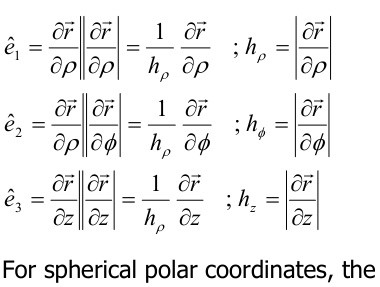
Rectangular Coordinate System
In the rectangular coordinate system, $(U_1,U_2,U_3)=(x,y,z)$ and
$$
\mathbf{r}=x\hat{\mathbf{i}}+y\hat{\mathbf{j}}+z\hat{\mathbf{k}}.
$$
Then
$$
h_x=h_{U_1}=1,\qquad h_y=h_{U_2}=1,\qquad h_z=h_{U_3}=1.
$$
Cylindrical Coordinate System
In the cylindrical coordinate system, $(U_1,U_2,U_3)=(\rho,\phi,z)$. The scale factors follow from the general formula above, giving the standard values for this system.
Unlock Complete Study Notes & Exam Traps
The full guide includes formal proofs, worked exemplar calculations, high-yield exam traps, and examiner marking schemes. Continue studying this topic in Mentify Prep Studio.