SMA 230 • UNIT 2 • Mathematics
Dot And Cross Product
Topics covered: Lesson Learning Outcomes, Find the magnitude of a vector, the unit vector and the resul, Magnitude, Unit Vector and Resultant, Assessment, Davis, H, Lewis, P, Spiegel, M, Tai, C
Syllabus Study Notes (Core Overview)
Free Overview Preview1. Core Concept Overview & Intuition
The algebra of vectors admits two distinct multiplicative operations. The first, the dot (scalar) product, consumes two vectors and returns a single real number. The second, the cross (vector) product, consumes two vectors and returns a third vector. These two products are the analytical engine for measuring lengths, angles, projections, areas, volumes, perpendicularity, coplanarity, and the geometry of planes and triangles in three-dimensional space.
The intuition behind the dot product is projection. When two vectors are placed tail-to-tail, the component of one vector lying along the direction of the other is obtained by multiplying its length by the cosine of the included angle. The dot product is precisely the product of one vector's magnitude with the signed projection of the other onto it. Consequently, the dot product is largest (equal to the product of magnitudes) when the vectors are parallel, and it vanishes when they are perpendicular, because a perpendicular vector casts no shadow along the other's direction.
The intuition behind the cross product is area and orientation. Two non-parallel vectors span a parallelogram; the cross product has magnitude equal to the area of that parallelogram and direction normal (perpendicular) to the plane containing the two vectors. The sense of that normal is fixed by the right-hand rule: if the fingers of the right hand curl from the first vector toward the second, the thumb points along the product vector. This orientation dependence is why the cross product is anti-commutative: reversing the order of the factors reverses the normal.
Both products are built from the same geometric data — the magnitudes of the two vectors and the angle between them — but they respond to that angle in complementary ways: the dot product tracks $\cos\theta$ and the cross product tracks $\sin\theta$. Because $\cos^2\theta+\sin^2\theta=1$, the two products together encode the full geometry of a pair of vectors.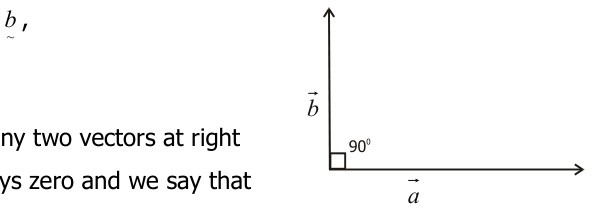
2. Mathematical Formalization & Core Definitions
2.1 The Dot (Scalar) Product
> Definition (Dot Product). If $A$ and $B$ are two vectors, the scalar product of $A$ and $B$ is defined as $AB\cos\theta$, where $A$ and $B$ are the magnitudes of the vectors $A$ and $B$, and $\theta$ is the angle between them. The scalar (dot) product is denoted $A\cdot B$.
Thus
$$
A\cdot B=AB\cos\theta
$$
and this quantity equals either $A$ times the projection of $B$ on $A$, or $B$ times the projection of $A$ on $B$. In either case the result is a scalar quantity.
Geometric reading of the definition. Consider two position vectors drawn from a common origin $O$, with $OA=7$ units and $OB=5$ units and an included angle of $45^{\circ}$. Then
$$
OA\cdot OB=OA\cdot OB\cos\theta=7\cdot 5\cos 45^{\circ}=35.2
$$
to three significant figures. The product is a pure number carrying the units of the product of the two lengths.
Special angles. The definition immediately yields three structural facts.
-
If $\theta=90^{\circ}$, then $a\cdot b=ab\cos 90^{\circ}=ab\cdot 0=0$. The scalar product of any two vectors at right angles is always zero, and the vectors are said to be orthogonal or perpendicular.
-
If the two vectors point in the same direction, then $\theta=0^{\circ}$ and $a\cdot b=ab\cos 0^{\circ}=ab$.
- If the two vectors point in opposite directions, then $\theta=180^{\circ}$ and $a\cdot b=-ab$.
2.2 The Dot Product in Component Form
Write the two vectors in component form as
$$
A=A_1\hat{i}+A_2\hat{j}+A_3\hat{k}
$$
$$
B=B_1\hat{i}+B_2\hat{j}+B_3\hat{k}
$$
Expanding the product bilinearly gives nine elementary products:
$$
\begin{aligned}
A\cdot B={}&A_1B_1\,\hat{i}\cdot\hat{i}+A_1B_2\,\hat{i}\cdot\hat{j}+A_1B_3\,\hat{i}\cdot\hat{k}\
&+A_2B_1\,\hat{j}\cdot\hat{i}+A_2B_2\,\hat{j}\cdot\hat{j}+A_2B_3\,\hat{j}\cdot\hat{k}\
&+A_3B_1\,\hat{k}\cdot\hat{i}+A_3B_2\,\hat{k}\cdot\hat{j}+A_3B_3\,\hat{k}\cdot\hat{k}
\end{aligned}
$$
Now $\hat{i}\cdot\hat{i}=\hat{j}\cdot\hat{j}=\hat{k}\cdot\hat{k}=1\cdot 1\cos 0^{\circ}=1$, while $\hat{i}\cdot\hat{j}=\hat{i}\cdot\hat{k}=\hat{j}\cdot\hat{k}=1\cdot 1\cos 90^{\circ}=0$. The six cross terms vanish and we are left with
$$
A\cdot B=A_1B_1+A_2B_2+A_3B_3
$$
This is the working formula for every dot-product computation.
2.3 The Cross (Vector) Product
> Definition (Cross Product). The cross or vector product of $A$ and $B$, written $A\times B$ and read " $A$ cross $B$ ", is defined as a vector having magnitude $AB\sin\theta$, where $\theta$ is the angle between the two vectors. The product vector acts in a direction perpendicular to $A$ and $B$ in such a sense that $A$, $B$, and $(A\times B)$ form a right-handed system in that order.
Thus
$$
\lvert A\times B\rvert=AB\sin\theta
$$
Right-handed axes. For vectors in space, axes of reference are normally defined by the right-hand rule. The axes $OX$, $OY$, $OZ$ form a right-handed set if rotation from $OX$ to $OY$ takes a right-handed corkscrew action along the positive direction of $OZ$; similarly, rotation from $OY$ to $OZ$ gives right-hand corkscrew action along the positive direction of $OX$, and so on cyclically.
Anti-commutativity. The product $B\times A$ reverses the direction of rotation, so the product vector acts downward; hence
$$
B\times A=-(A\times B)
$$
Special angles. If $\theta=0^{\circ}$, then $A\times B=AB\sin 0^{\circ}=0$, so parallel vectors have zero cross product. If $\theta=90^{\circ}$, then $A\times B=AB\sin 90^{\circ}=AB$, so the magnitude is maximal for perpendicular vectors.
2.4 The Cross Product in Component Form
Expanding bilinearly as before,
$$
\begin{aligned}
A\times B={}&A_1B_1\,\hat{i}\times\hat{i}+A_1B_2\,\hat{i}\times\hat{j}+A_1B_3\,\hat{i}\times\hat{k}\
&+A_2B_1\,\hat{j}\times\hat{i}+A_2B_2\,\hat{j}\times\hat{j}+A_2B_3\,\hat{j}\times\hat{k}\
&+A_3B_1\,\hat{k}\times\hat{i}+A_3B_2\,\hat{k}\times\hat{j}+A_3B_3\,\hat{k}\times\hat{k}
\end{aligned}
$$
Since $\hat{i}\times\hat{i}=1\cdot 1\sin 0^{\circ}=0$, we have $\hat{i}\times\hat{i}=\hat{j}\times\hat{j}=\hat{k}\times\hat{k}=0$. Also $\hat{i}\times\hat{j}=1\cdot 1\sin 90^{\circ}=1$ in the direction $OZ$, that is $\hat{i}\times\hat{j}=\hat{k}$. The complete multiplication table of the basis vectors is
$$
\hat{i}\times\hat{j}=\hat{k},\qquad \hat{j}\times\hat{k}=\hat{i},\qquad \hat{k}\times\hat{i}=\hat{j}
$$
$$
\hat{j}\times\hat{i}=-\hat{k},\qquad \hat{k}\times\hat{j}=-\hat{i},\qquad \hat{i}\times\hat{k}=-\hat{j}
$$
Collecting terms gives
$$
A\times B=(A_2B_3-A_3B_2)\hat{i}+(A_3B_1-A_1B_3)\hat{j}+(A_1B_2-A_2B_1)\hat{k}
$$
which is recognized as the expansion of the determinant
$$
A\times B=
\begin{vmatrix}
\hat{i} & \hat{j} & \hat{k}\
A_1 & A_2 & A_3\
B_1 & B_2 & B_3
\end{vmatrix}
$$
The determinant form is the standard computational device: expand along the first row, remembering the alternating signs $+,-,+$.
Unlock Complete Study Notes & Exam Traps
The full guide includes formal proofs, worked exemplar calculations, high-yield exam traps, and examiner marking schemes. Continue studying this topic in Mentify Prep Studio.
Verified Examination Problems
3 verified questions in catalogQuestion 1 (3 marks)
Prove that the dot product is commutative, that is, for any two vectors $\vec{A} = (A_1, A_2, A_3)$ and $\vec{B} = (B_1, B_2, B_3)$, we have $\vec{A} \cdot \vec{B} = \vec{B} \cdot \vec{A}$.
Question 1 (3 marks)
Prove that the dot product is commutative, that is, (\vec{A} \cdot \vec{B} = \vec{B} \cdot \vec{A}) for any two vectors (\vec{A} = (A_1, A_2, A_3)) and (\vec{B} = (B_1, B_2, B_3)).
Access all authentic past questions, interactive AI hint generation, and full marking rubrics in the course studio.
Unlock All Questions in Studio →