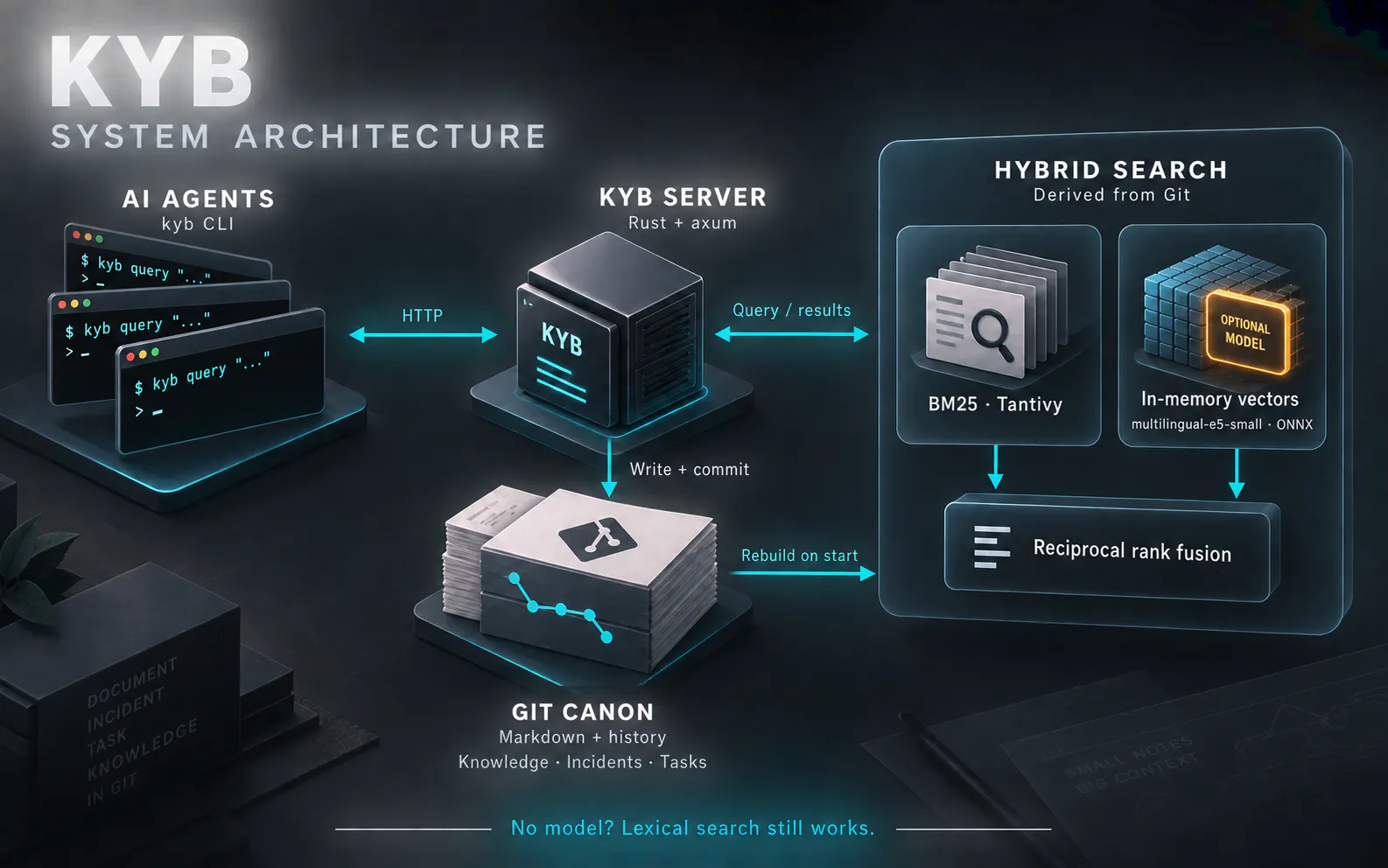
Git-Backed Shared Memory for AI Agents: Hybrid Search and Temporal Retrieval in Production
Multi-agent systems have a memory problem that nobody solved cleanly. Vector databases give you semantic recall but no audit trail. Key-value stores give you speed but no history. And the moment two agents write to the same memory namespace, you inherit every concurrency headache that distributed systems engineers spent the last two decades trying to forget. A HackerNoon piece published this morning lays out an architecture that treats Git as the durable substrate for agent memory, then bolts hybrid retrieval and temporal queries on top. It is the kind of design that looks obvious in retrospect and terrifying once you start counting the fsync calls.
The core claim is straightforward: if your agents already produce text artifacts (plans, tool outputs, reflections, retrieved documents), then a commit graph is the most natural place to store them. Every write becomes a commit. Every agent gets a branch. Merges become conflict resolution. And git log becomes your temporal index for free. The interesting engineering is in what you have to build around that substrate to make it usable at agent speed.
The Commit Graph as a Memory Namespace
Trailers matter more than they look. They give you a parseable metadata layer without a separate schema, and git log --format can extract them at roughly 40,000 commits per second on a warm object store. The HackerNoon author leans on this for temporal retrieval: "what did agent 07 believe about pricing at 14:00 UTC" becomes a git rev-list --before query rather than a bespoke time-series table.
The trade-off is object count. A busy swarm writing one commit per tool call generates 50,000 to 200,000 commits per day per agent. Git handles that fine on the commit side, but git gc on a repo with 40 million loose objects is not a background task you want running during inference. The article suggests sharding memory repos by session or by week, which is sensible, though it complicates cross-session recall.
Hybrid Retrieval: BM25 Over the Tree, Vectors Over the Blobs
The retrieval layer is where the design earns its keep. Pure vector search over agent memory has a well-documented failure mode: it retrieves semantically similar text that is factually stale or from the wrong agent. The HackerNoon approach runs two retrievers in parallel and fuses them with reciprocal rank fusion (RRF, k=60):
- Lexical: BM25 over commit messages and structured trailers, indexed incrementally as commits land. This catches exact identifiers, tool names, and error codes that embeddings smear.
- Semantic: ANN search over chunked blob contents, with embeddings stored in a sidecar index keyed by blob SHA.
Keying the vector index by blob SHA is the clever part. Git already deduplicates identical content across branches, so the embedding cache inherits that deduplication. If three agents independently retrieve the same document, you embed it once. In a swarm where retrieval overlap is high, that cuts embedding spend by 30 to 60 percent depending on workload.
The fusion step is cheap (sub-millisecond for top-100 candidate lists), but the ANN query is not. On a 10-million-chunk index with HNSW (M=32, efSearch=128), expect 8 to 15 ms p50 and 40 to 70 ms p99 on a single node. Add BM25 at 2 to 5 ms and RRF at under 1 ms, and you are looking at roughly 25 ms p50 retrieval latency before you touch the Git object store.
Temporal Retrieval and the Cost of rev-list
This is O(commits) in the worst case. On a repo with 5 million commits, a cold rev-list --before runs 300 to 900 ms. That is fine for an audit query and unacceptable for an agent that needs to answer "what did we know at 14:00" inside a 2-second tool budget.
The article's mitigation is a materialized temporal index: a sidecar SQLite or DuckDB table mapping (namespace, timestamp) -> commit_sha, rebuilt incrementally on every push via a post-receive hook. With that index, temporal lookup drops to a single B-tree seek, 0.2 to 0.8 ms. The cost is consistency: the hook can lag, so you need a fallback to rev-list when the index is behind the ref. In practice, a 5-second staleness window is acceptable for most agent recall, but not for compliance-grade audit trails.
Concurrency, Conflicts, and the Merge Tax
Git's merge model is the design's biggest liability for agent memory. Two agents writing to the same memory file produce a conflict, and LLM-driven conflict resolution is expensive and non-deterministic. The HackerNoon piece sidesteps this by making memory append-only: each write is a new file under a content-addressed path, so textual conflicts never occur. Merges become fast-forward or trivial tree merges.
That works until you need compaction. Append-only memory grows without bound, and eventually you need to summarize old entries into a consolidated record. Compaction is a rewrite, rewrites conflict, and now you are back to merge resolution. The article acknowledges this but does not fully solve it; the suggested approach is a single-writer compaction agent that rebases onto memory/main before pushing, which serializes compaction but keeps it off the hot path.
There is also the push contention problem. Git's ref update is compare-and-swap, so concurrent pushes to the same branch fail and retry. With 200 agents pushing to memory/main, you get retry storms. The fix is per-agent branches plus a periodic fan-in job, which trades latency (memory is not immediately visible to other agents) for throughput. The article reports a fan-in interval of 30 seconds in their reference deployment, which means cross-agent recall has a 30-second visibility lag. For most swarm workloads that is fine; for real-time coordination it is not.
Latency Budget: Where the Milliseconds Go
Pulling the numbers together for a single recall operation (top-10 results, hybrid, temporal filter):
| Stage | p50 | p99 |
|---|---|---|
| Temporal index lookup | 0.4 ms | 1.2 ms |
| BM25 over commit trailers | 3 ms | 9 ms |
| HNSW ANN (10M chunks) | 11 ms | 62 ms |
| RRF fusion | 0.6 ms | 1.8 ms |
| Blob fetch from object store | 6 ms | 28 ms |
| Total | 21 ms | 102 ms |
The p99 is dominated by ANN and blob fetch, both of which are cacheable. A warm blob cache (LRU, 2 GB) drops blob fetch to under 1 ms for repeat recalls, which in agent workloads is the common case. The ANN tail is harder; the article suggests reducing efSearch to 64 for agent recall (quality loss is modest for top-10) and sharding the index by namespace to keep each shard under 2 million vectors.
Operational Realities the Post Glosses Over
Three things deserve more scrutiny than the HackerNoon piece gives them.
Object store costs. Git repos on S3-backed storage accrue GET charges fast. A recall that touches 50 blobs at $0.0004 per 1,000 GETs is negligible per query, but at 10 million recalls per day it becomes a line item. The article's dedup helps, but you still need a local blob cache to keep costs sane.
Garbage collection vs. temporal queries. git gc prunes unreachable objects, and aggressive gc can invalidate temporal index entries pointing at commits that are no longer reachable from any ref. If you rely on rev-list for audit, you must keep all commits reachable, which means no pruning, which means unbounded growth. The resolution is to archive old memory repos to cold storage rather than gc them, but that breaks the single-repo temporal query model.
Security and prompt injection. Agent memory is a prompt injection vector. If one agent writes a malicious instruction into shared memory and another agent retrieves it, you have a cross-agent injection path. Git's commit signing (SSH or GPG) gives you provenance, and the article recommends verifying signatures at retrieval time, but signature verification on every blob fetch adds 1 to 3 ms per commit and requires key management for every agent. It is the right call, but it is not free.
What This Pattern Is Actually Good For
The Git-backed memory design is not a general-purpose vector store replacement. It is a good fit for three workloads: long-horizon agent tasks where auditability matters, multi-agent swarms where write provenance is essential, and research pipelines where reproducibility of retrieved context is a hard requirement. It is a poor fit for high-frequency, low-latency recall (sub-10 ms p99), for workloads with heavy write contention on shared namespaces, and for any system where unbounded storage growth is a non-starter.
The HackerNoon contribution is less a novel algorithm than a coherent composition: Git for durability and provenance, hybrid retrieval for recall quality, temporal indexing for point-in-time queries. Each piece exists independently. The value is in the seams, and the seams are where the latency and operational costs live. If you are building agent memory in late 2026, this is a credible reference architecture, provided you budget for the blob cache, the temporal sidecar, and the compaction agent before you ship.
For teams already running Git-backed config or infrastructure repos, the migration path is short: reuse your existing object store, add the sidecar index, and keep memory repos separate from code repos so gc policies do not collide. The rest is tuning.